
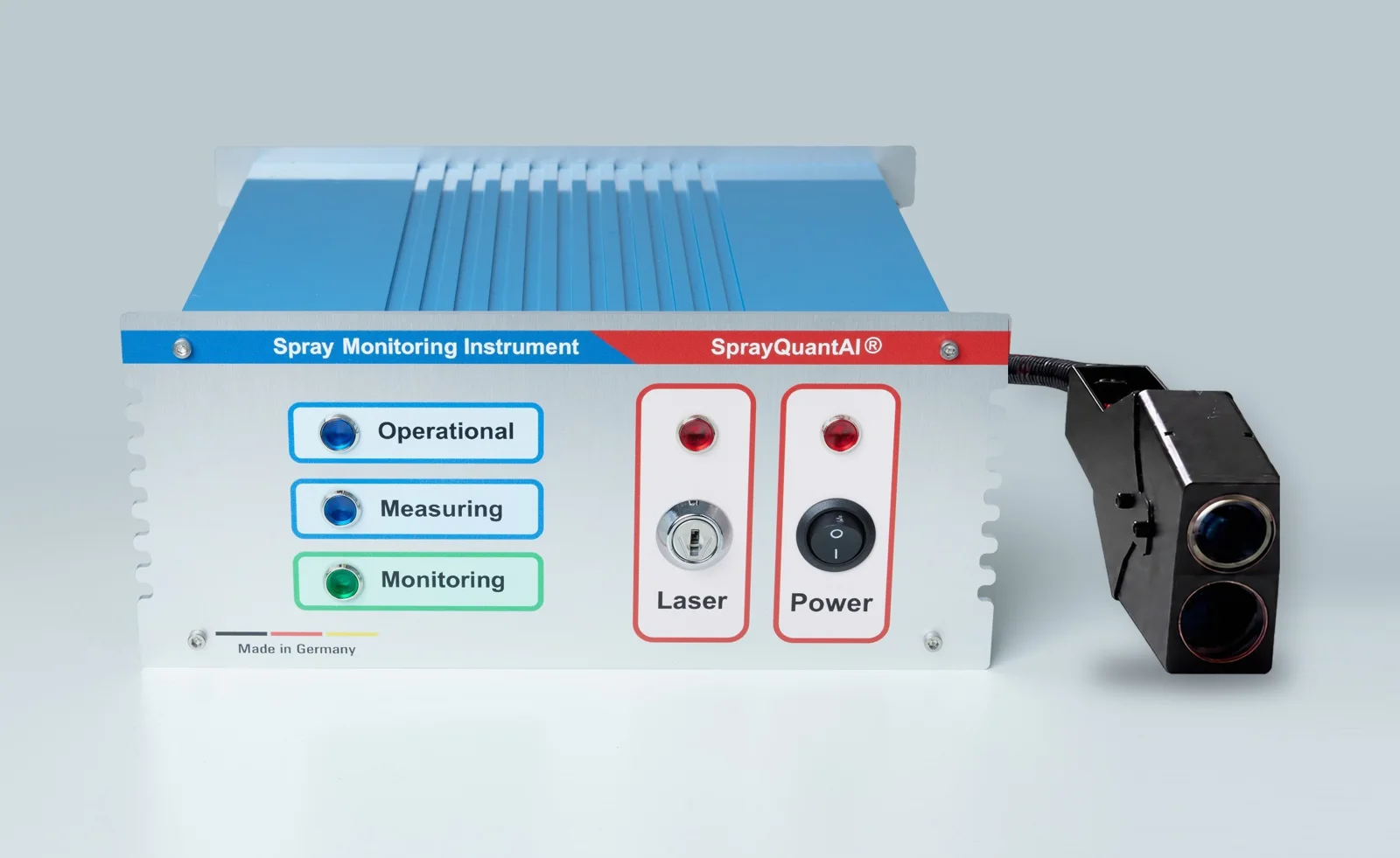
SprayQuantAI® and ParticleTensorAI® use time-resolved light-scattering signals. The detector configuration determines which information is recorded, while the evaluation method determines how this information is converted into measurement results.
SprayQuantAI® and ParticleTensorAI®
SprayQuantAI® — Individual Droplet Analysis
SprayQuantAI® evaluates individual droplet events using classical or AI-based methods, depending on the configuration and software. Measurement results include droplet size, velocity and number. SQA2 adds the relative timing between two detector signals, providing additional information for droplet-composition analysis with a suitable configuration and evaluation method.
ParticleTensorAI® — AI-Based Tensor Analysis
ParticleTensorAI® represents buffered light-scattering signal sequences as multidimensional tensors for AI-based analysis. Depending on the measurement task, optical configuration and trained model, the analysis can characterize particle and droplet populations, material-related properties or changes in a process. PTA1, PTA2 and PTA4 provide one, two or four detector channels.
System Comparison: SQA1, SQA2, PTA1, PTA2 and PTA4
The table compares the hardware, evaluation methods and available signal information of all five configurations. Additional detector channels extend the information available for analysis; they do not by themselves define the final measurement outputs.
| System | Detector channels | Probe + control unit | Evaluation method | Available signal information |
|---|---|---|---|---|
| SQA1 | 1 | LSS1 + ZEON | Classical or AI-based evaluation of individual droplet events | Shape and parameters of individual time-resolved light-scattering signals. |
| SQA2 | 2 | LSS2 + IMEA | Classical or AI-based evaluation of individual droplet events | Signal shapes and parameters from both channels, plus the relative time shift between signals associated with the same droplet. |
| PTA1 | 1 | LSS1 + ZEON | AI-based tensor analysis | Signal shapes and parameters within one buffered light-scattering signal stream. |
| PTA2 | 2 | LSS2 + IMEA | AI-based tensor analysis | Signal shapes and parameters from two synchronized streams, plus relative timing between corresponding signals. |
| PTA4 | 4 | LSS4 + CLEON | AI-based tensor analysis | Signal shapes and timing relationships across four channels, supporting more accurate velocity measurement. Depending on the optical configuration, wavelength or polarization provides an additional analysis parameter. |
What Do Additional Detectors Add?
One Detector: Signal Shape and Parameters
SQA1 and PTA1 record a single time-resolved light-scattering signal stream. The available information comes from the signal shape and its parameters, including temporal features within each signal. SQA1 evaluates individual droplet events; PTA1 evaluates buffered sequences through AI-based tensor analysis.
Two Detectors: Additional Relative Timing
SQA2 and PTA2 add a second synchronized detector channel. In addition to the shape and parameters of each signal, the relative time shift between corresponding signals becomes available. This provides an additional relationship between scattering events from the same droplet or particle.
Four Detectors: More Accurate Velocity and Additional Optical Information
PTA4 extends the acquisition to four detector channels. The additional timing information supports more accurate velocity measurement. With the appropriate optical arrangement, wavelength or polarization also becomes an analysis parameter, adding information about the optical response of the droplets or particles.
Shared Hardware, Different Evaluation Methods
SQA1 and PTA1 use the LSS1 probe with the ZEON control unit. SQA2 and PTA2 use the LSS2 probe with the IMEA control unit. Although these pairs share a hardware platform, the electronics configuration and software are adapted to the selected measurement method. PTA4 combines the LSS4 probe with the CLEON control unit.
SprayQuantAI® supports classical or AI-based evaluation, depending on the selected configuration. ParticleTensorAI® uses AI-based tensor analysis only. The optical setup, calibration and, for AI-based methods, the training data and validation determine which measurement results are available for a particular application.
From Light Scattering to Measurement Results
When a droplet or particle passes through a specifically shaped light field, optical detectors record time-dependent scattered-light signals. Their shapes, parameters and, in multi-channel systems, relative timing contain information about the measured droplets or particles.
The selected system evaluates this information using physical models, signal-processing methods or AI. Applications include spray and atomizer research, coating-process monitoring and material-related investigations in particle-laden flows.
SprayConeAI® — Image-Based Spray Analysis
SprayConeAI® complements the light-scattering systems with image-based analysis of spray cones and spray patterns. The web-based tool uses images captured with a smartphone, tablet or camera. It uses a different data source and is therefore presented separately from the detector-based SQA and PTA configurations.
Discuss Your Measurement Task
Tell us which droplets, particles or process changes you want to characterize. We can help define the detector configuration, optical setup and evaluation method for your application.