
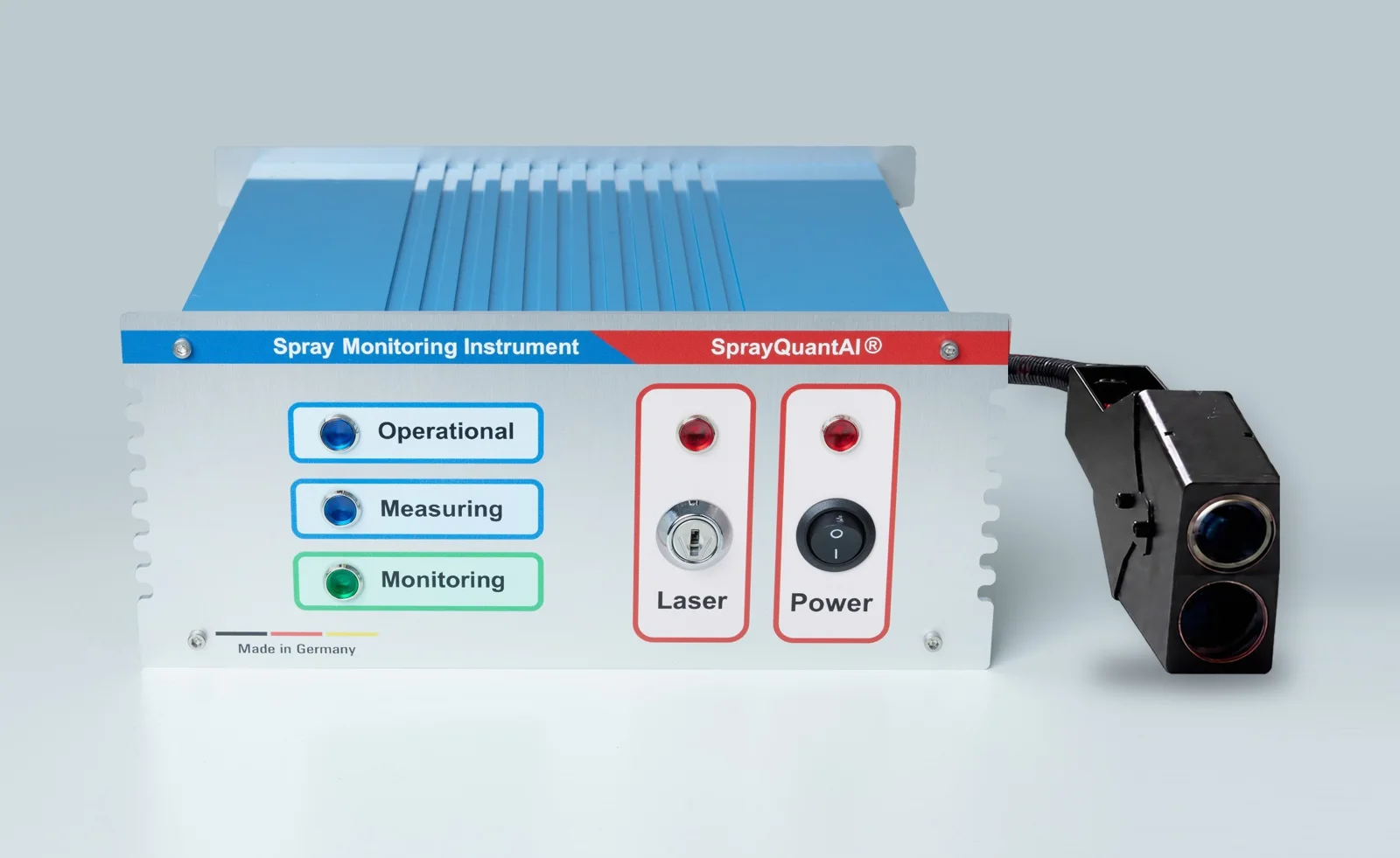
The SprayQuantAI® Concept
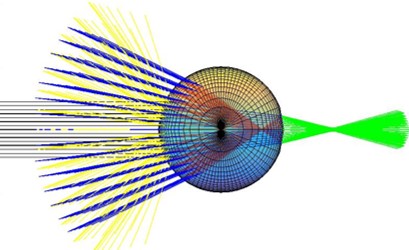
When a droplet passes through a shaped light field, it produces a time-dependent light-scattering signature. The recorded signal shape, signal parameters and timing features contain information about the droplet and its interaction with the light.
SprayQuantAI® evaluates this signature droplet by droplet. Depending on the detector configuration, the signature consists of a single detector signal or synchronized signals from the same droplet. Individual-droplet analysis therefore does not mean that only one detector can be used.
From Individual Droplets to Spray Information
The evaluation provides droplet size, velocity and number or rate, depending on the selected configuration and method. Combining the results from many individually detected droplets produces distributions and time-dependent information about the spray.
Additional optical or material-related properties can be investigated when they are represented in the measured signature and supported by the optical setup and evaluation method. For example, the relative timing between two detector signals can provide additional information for droplet-composition analysis.
Classical and AI-Based Evaluation
SprayQuantAI® supports classical TSTOF calculations [1][2] and AI-based signal evaluation [3][4]. Classical methods use defined signal features and physical relationships. AI-based methods use models trained with suitable reference data to evaluate the light-scattering signature.
Both approaches retain the same central concept: the measurement is based on the signature of an individual droplet. The selected method, calibration and validation determine which properties can be obtained for the application.
SprayQuantAI®, ParticleTensorAI® and SprayConeAI® Compared
The three platforms address different levels of spray characterization: individual droplet signatures, buffered light-scattering sequences and images of the spray.
| Platform | Data evaluated | Analysis concept | Main focus |
|---|---|---|---|
| SprayQuantAI® | Light-scattering signature of an individual droplet | Classical or AI-based evaluation, droplet by droplet | Droplet properties and spray statistics derived from individual events |
| ParticleTensorAI® | Buffered light-scattering sequences represented as tensors | AI-based analysis of patterns across a recorded interval | Application-specific particle, material and process characterization |
| SprayConeAI® | Images of spray cones and spray patterns | Image-based analysis | Spray-cone geometry and spatial spray patterns |
ParticleTensorAI® evaluates signal sequences without requiring every droplet event to be separated before analysis. SprayConeAI® evaluates the visible spray geometry from images. SprayQuantAI® focuses on the optical signature associated with each individually detected droplet.
References
[1] W. Schaefer, L. Li, P. Stegmann, and M. Terada, “TSTOF測定法に関する技術報告書:第一部 ─ 技術的基礎、歴史的発展、および他のレーザー測定法との比較,” J. Coat. Technol. Res., vol. 61, no. 3, Art. no. 100, 2026. [Online]. Available: https://jcot.or.jp/download/61-03-2.pdf
[2] W. Schaefer, L. Li, P. Stegmann, and M. Terada, “Technical report on the TSTOF measurement method: Technical basics, historical development, and comparison with other laser-based measurement methods,” Photonics, vol. 13, no. 1, Art. no. 56, 2026, doi: 10.3390/photonics13010056. https://www.mdpi.com/2304-6732/13/1/56
[3] W. Schaefer and L. Li, “Particle characterization by analyzing light scattering signals with a machine learning approach,” in Proc. 16th Triennial Int. Conf. Liquid Atomization and Spray Systems (ICLASS), Shanghai, China, 2024. http://ilassasia.org/iclass-2024/
[4] W. Schaefer and L. Li, “Particle characterization by analyzing light scattering signals with a machine learning approach,” Appl. Opt., vol. 63, no. 29, pp. 7701–7711, Oct. 2024, doi: 10.1364/AO.531346. https://opg.optica.org/ao/abstract.cfm?uri=ao-63-29-7701