
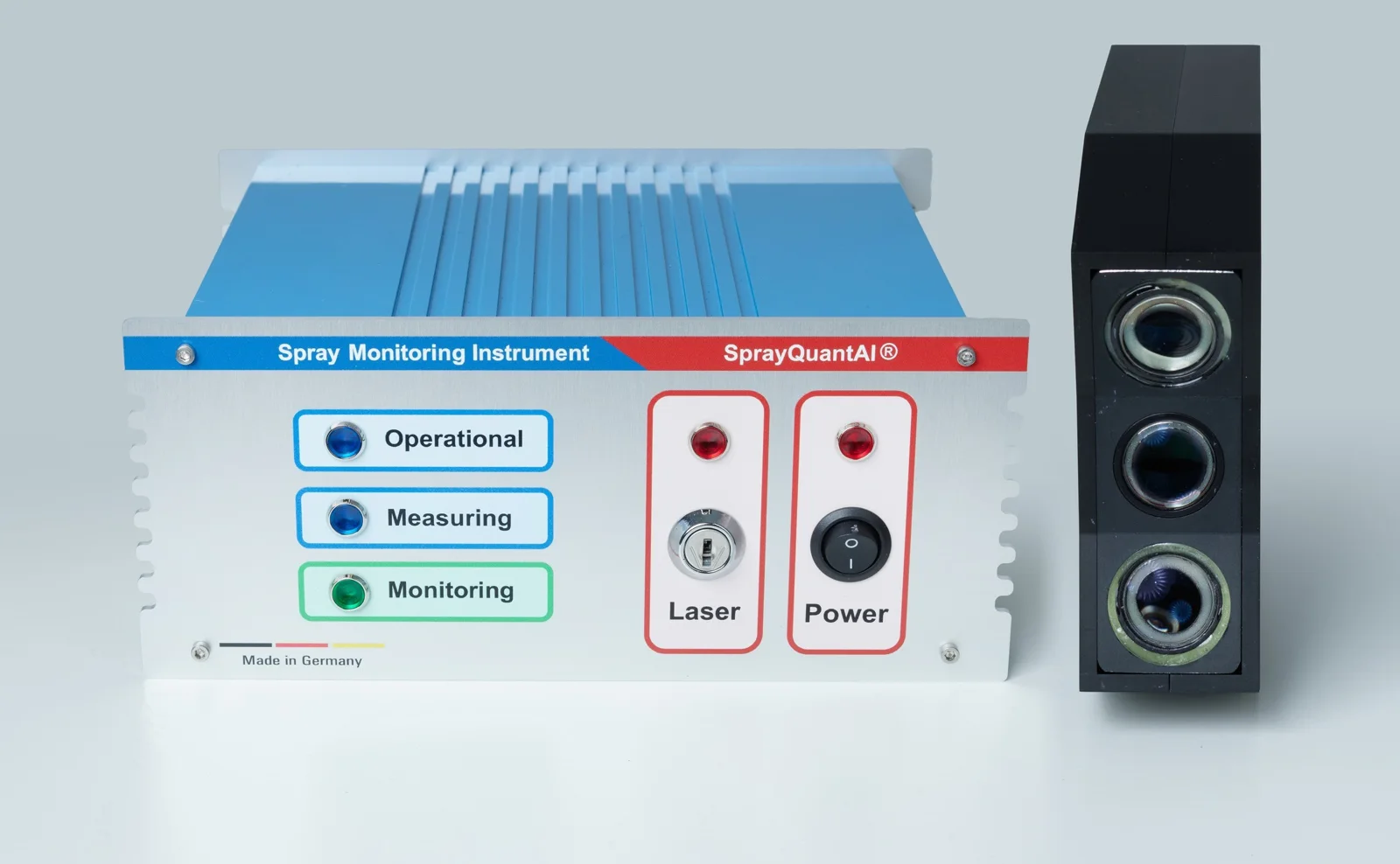
SQA1 evaluates the shape and parameters of a signal recorded by one detector. SQA2 adds a second synchronized detector, providing the relative time shift between signals associated with the same droplet. The advantages of SQA1 over SQA2 are its compact design and price. SQA2, on the other hand, can determine the composition of droplets through its additional light scattering signal.
SQA1 and SQA2 at a Glance
| Feature | SQA1 | SQA2 |
|---|---|---|
| Optical measurement probe | LSS1 | LSS2 |
| Control unit | ZEON | IMEA |
| Detector channels | 1 | 2 synchronized channels |
| Signal information | Shape and parameters of individual light-scattering signals | Signal shapes and parameters from both channels, plus the relative time shift between corresponding signals |
| Timing information | Temporal features within a single detector signal | Temporal features within each signal and the timing relationship between the two detector channels |
| Droplet measurement | Size, velocity and number, depending on configuration and evaluation | Size, velocity and number, with additional information for droplet-composition analysis using a suitable configuration and evaluation method |
| Evaluation methods | Classical or AI-based | Classical or AI-based |
| System details | Explore SQA1 | Explore SQA2 |
SQA1 — Single-Detector Configuration
SQA1 combines the LSS1 optical measurement probe with the ZEON control unit. One detector records the time-dependent light-scattering signal generated as a droplet passes through the measurement region.
The signal shape and its parameters provide the information for evaluating individual droplet events. This includes temporal features within the signal. SQA1 is suitable for applications that require droplet characterization from a single detector channel.
SQA2 — Two-Detector Configuration
SQA2 combines the LSS2 optical measurement probe with the IMEA control unit. Two synchronized detector channels record light-scattering signals associated with the same droplet.
In addition to the shape and parameters of each signal, SQA2 provides the relative time shift between the two signals. Their temporal sequence supplies additional information about the scattering events. With a suitable optical configuration, calibration and evaluation method, this information can support analysis of droplet composition.