
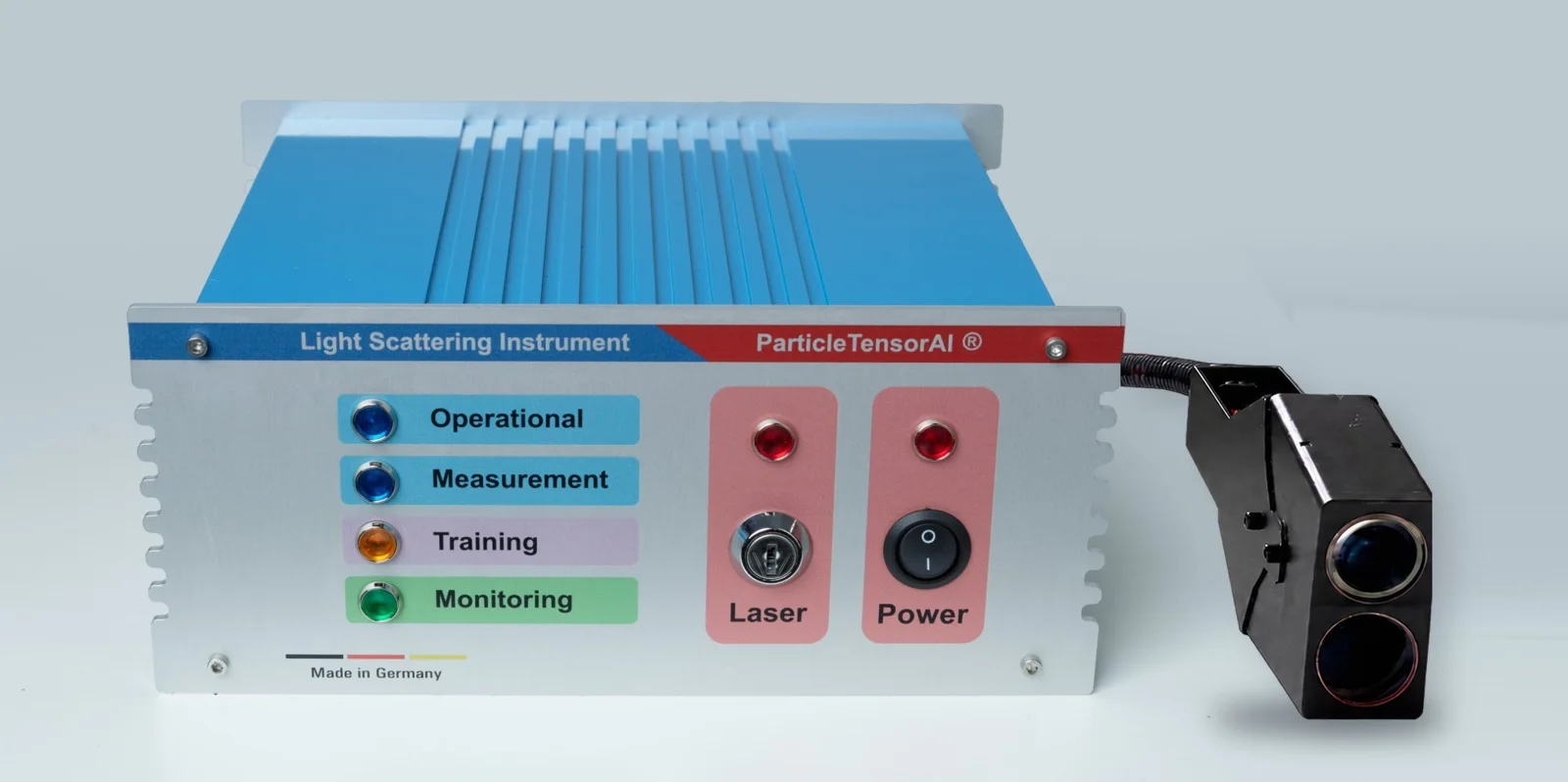

The ParticleTensorAI® Concept
As droplets or particles pass through a shaped light field, optical detectors record a stream of time-dependent scattering signals. ParticleTensorAI® retains a selected interval of this stream and represents it as a tensor for AI-based evaluation.
The analysis considers patterns across the recorded interval without requiring each droplet event to be isolated first. Signal shapes, intensities, temporal structure and relationships between detector channels can contribute information to the model. A Particle Tensor represents measured optical signals; it is not a camera image of the spray.
From Signal Sequences to Material and Process Information
Depending on the measurement setup and the validated model, ParticleTensorAI® can estimate or classify properties such as average suspended-particle size, mass concentration and material-related optical characteristics. It can also be used to investigate changes in material composition or spray conditions.
The central concept is to obtain information from the combined structure of a signal sequence. The available outputs depend on the optical configuration, reference data and model developed for the application.
AI-Based Tensor Evaluation
ParticleTensorAI® operates exclusively with AI-based evaluation. During model development, recorded tensors are related to reference measurements or defined material and process conditions. Validation establishes how reliably the model can estimate properties or distinguish conditions within the intended application.
The tensor representation organizes the recorded information for analysis. Its usefulness depends on preserving the signal features relevant to the measurement task and using an appropriate evaluation model.
ParticleTensorAI®, SprayQuantAI® and SprayConeAI® Compared
The three platforms address different levels of spray characterization: buffered light-scattering sequences, individual droplet signatures and images of the spray.
| Platform | Data evaluated | Analysis concept | Main focus |
|---|---|---|---|
| ParticleTensorAI® | Buffered light-scattering sequences represented as tensors | AI-based analysis of patterns across a recorded interval | Application-specific particle, material and process characterization |
| SprayQuantAI® | Light-scattering signature of an individual droplet | Classical or AI-based evaluation, droplet by droplet | Droplet properties and spray statistics derived from individual events |
| SprayConeAI® | Images of spray cones and spray patterns | Image-based analysis | Spray-cone geometry and spatial spray patterns |
SprayQuantAI® processes the light-scattering signature of each individually detected droplet. ParticleTensorAI® evaluates the patterns within a buffered signal sequence. SprayConeAI® uses images to analyze the visible spray geometry.
References
[1] W. Schaefer, “KI-gestütztes Verfahren zur Analyse eines Ensembles dynamischer Teilchen oder einer Teilchenwolke durch Auswertung eines aus einem kontinuierlichen Datenstrom von Lichtstreusignalen generierten Bildes,” German patent application DE 10 2025 120 569.8, filed May 27, 2025.
[2] W. Schaefer, T. Jakobs, and P. Stegmann, “AI-assisted monitoring of coal particles within droplets in a coal monoethylene glycol slurry spray,” in Proc. 41st Int. Symp. on Combustion (ISOC), Kyoto, Japan, Jul. 26–31, 2026, Combustion Institute, doi: 10.5445/IR/1000196272. [Online]. Available: https://publikationen.bibliothek.kit.edu/1000196272.
[3] W. Schäfer, T. Jakobs, and P. Stegmann, “KI-gestützte, Tensor basierte Charakterisierung von Tropfen und Partikeln aus kontinuierlichen Lichtstreusignalen,” in Jahrestreffen der DECHEMA/VDI-Fachgruppen Kristallisation und Trocknungstechnik 2026, Frankfurt am Main, Germany, Mar. 4–6, 2026. https://dechema.de/JTR_KRI_TRO_2026.html