
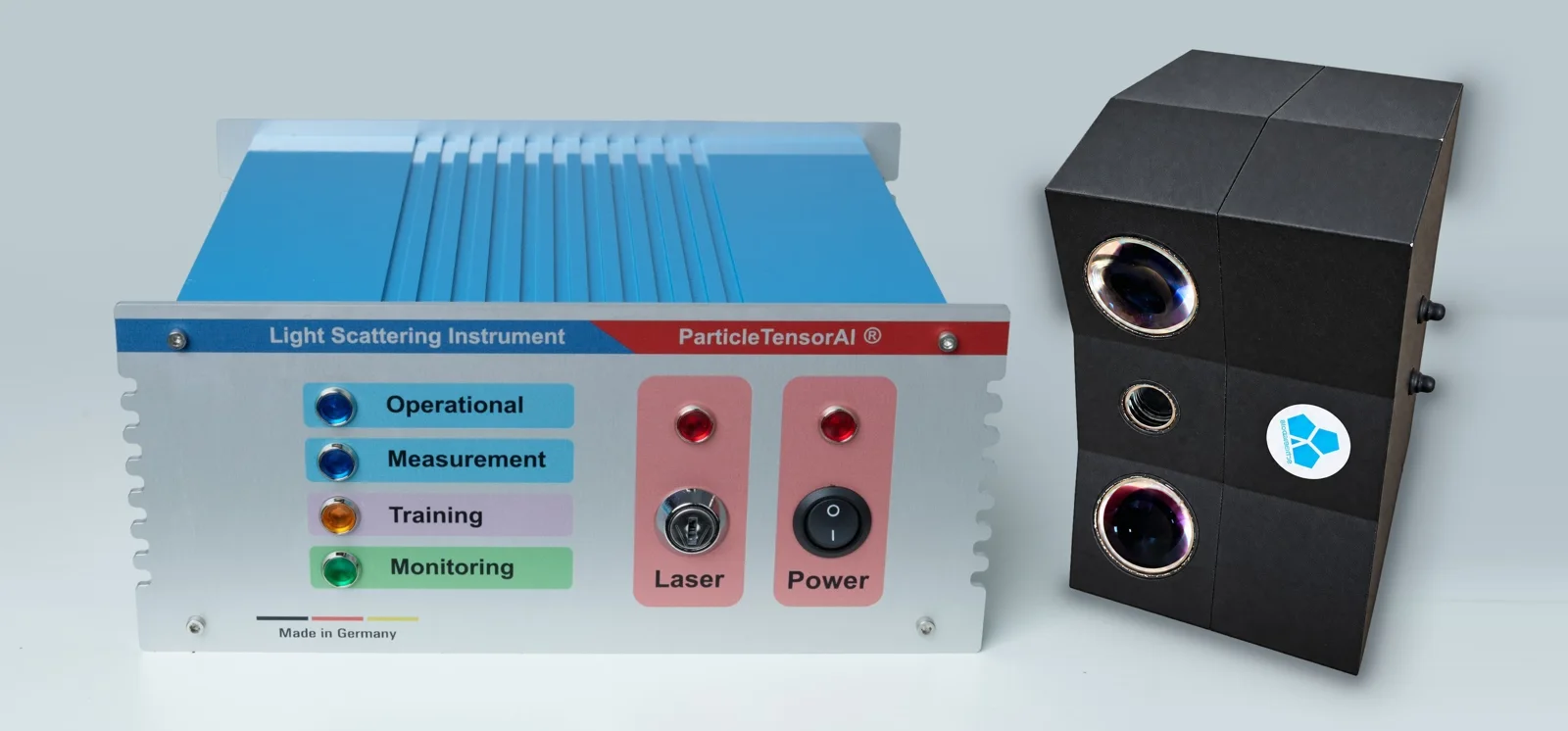
Configuration Overview
| System | Optical probe | Control unit | Detector channels | Hardware platform |
|---|---|---|---|---|
| PTA1 | LSS1 | ZEON | 1 | Based on the SQA1 platform |
| PTA2 | LSS2 | IMEA | 2 | Based on the SQA2 platform |
| PTA4 | LSS4 | CLEON | 4 | Based on the TSTOF hardware platform |
PTA1: Single-Channel Configuration
PTA1 combines the LSS1 optical probe with the ZEON control unit and uses one detector channel. Its calculation electronics are configured for ParticleTensorAI® signal acquisition and AI-based tensor analysis.
PTA2: Two-Channel Configuration
PTA2 combines the LSS2 optical probe with the IMEA control unit and uses two detector channels. The recorded signals provide two channels of time-resolved light-scattering data for ParticleTensorAI® analysis.
PTA4: Four-Channel Configuration
PTA4 combines the LSS4 optical probe with the CLEON control unit and uses four detector channels. It applies the ParticleTensorAI® approach to buffered signal data from the four-channel measurement configuration.
Shared Evaluation Approach
All three configurations use AI-based evaluation. The recorded detector signals are retained over a defined measurement interval and arranged as Particle Tensors for analysis by an AI model developed for the measurement task.
The number of detector channels determines how many optical signal streams are available to the analysis. The most suitable configuration depends on the measurement task and the information required from the recorded signals. The value of each detector channel must be evaluated and validated for the intended application.
Selecting a Configuration
Configuration selection begins with the physical measurement question: the spray or particle system, the properties to be investigated, the available reference data, and the AI model to be developed and validated. A higher detector-channel count provides additional signal streams, while its benefit depends on the application and the information contained in those signals.
For the underlying analysis principle, see ParticleTensorAI® Overview and the ParticleTensorAI® measurement-principle pages.