
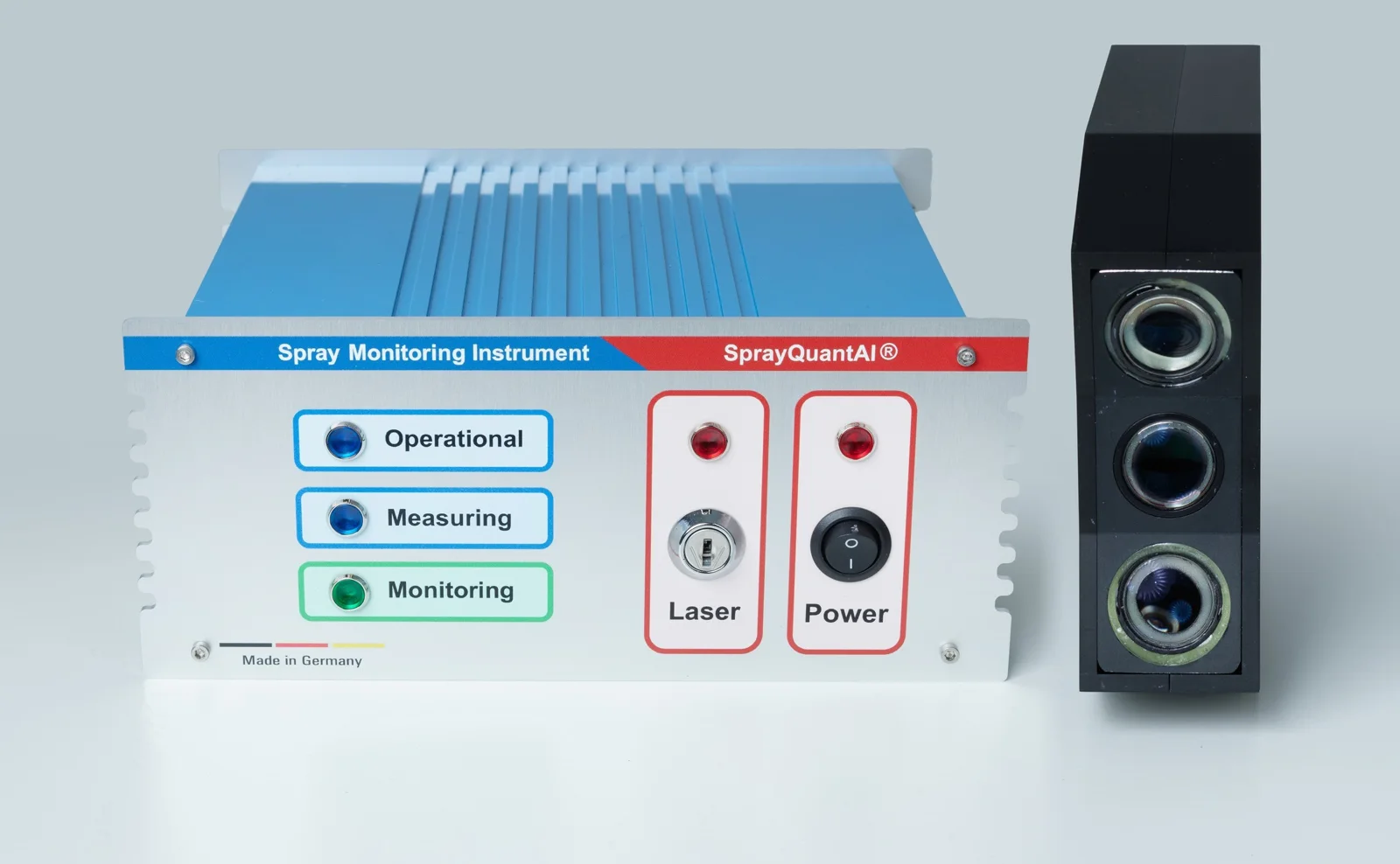
SQA2 System Configuration
SQA2 consists of two main hardware components:
- LSS2 optical measurement probe
- IMEA control unit
The LSS2 configuration uses two synchronized active detector channels. The detector signals are recorded in relation to the same measurement event and provide input for the configured signal-processing method.
The two recorded light-scattering signals provide information about the time shift between scattering events generated by the same droplet. By analysing the sequence and timing of these signals, SQA2 can detect differences in droplet composition.
SprayQuantAI® SQA2 extends the SQA1 platform with a second synchronized detector channel. It is designed for the time-resolved characterization of individual droplets in sprays and flows, with optional analysis of droplet composition. The system combines the dual-channel LSS2 optical probe with the IMEA control unit.
Measurement Principle
When a droplet passes through the illuminated measurement region, it scatters part of the incident laser light toward the detectors. LSS2 records time-resolved signals through its two synchronized active detector channels.
The signal data are transferred to the IMEA control unit for acquisition and processing. Depending on the selected evaluation method and calibration, SprayQuantAI® can determine quantities such as droplet size, velocity and droplet rate.
For AI-based evaluation, a trained model analyses the measured signal data. The model uses relationships learned from reference measurements to estimate the selected droplet properties. The training and validation data must be suitable for the intended measurement setup and application.
For more information about the two evaluation approaches, see the pages on the classical measurement principle [1][2] and AI-based measurement principle [3][4].
Typical Optical Configuration
| Parameter | Typical configuration |
|---|---|
| Optical probe | LSS2 |
| Control unit | IMEA |
| Active detector channels | 2, synchronized |
| Typical working distance | 125 mm |
| Available working distances | 62.5 mm, 125 mm and 250 mm |
| Typical laser wavelength | 405 nm |
| Typical laser power | 3 mW |
Measurement and Data Processing
The IMEA control unit connects the optical probe to the signal-processing and measurement software. It acquires the synchronized detector signals and provides the processed measurement data to the selected host or interface.
Depending on the application and software configuration, the system can provide individual droplet results and statistical spray parameters. Available outputs and interfaces depend on the selected IMEA configuration.
References
[1] W. Schaefer, A. Hänsel, and D. Wolter, “Sprühstrahl dynamisch messen: Neue Methode soll die manuelle Nasslackierung unterstützen,” BESSER LACKIEREN, no. 12, p. 11, Dec. 2026. https://www.besserlackieren.de/technik-produkte/mess-und-prueftechnik/spruehstrahl-dynamisch-messen/
[1] W. Schaefer, S. Fleck, M. Haas and T. Jakobs, “Optical measurement method for monitoring high-mass-concentration slurry sprays: An experimental study,” Photonics, vol. 12, no. 7, Art. no. 673, 2025, doi: 10.3390/photonics12070673. https://www.mdpi.com/2304-6732/12/7/673
[3] W. Schaefer and L. Li, “Particle characterization by analyzing light scattering signals with a machine learning approach,” Appl. Opt., vol. 63, no. 29, p. 7701, Oct. 2024, doi: 10.1364/AO.531346. https://opg.optica.org/ao/abstract.cfm?uri=ao-63-29-7701
[4] W. Schaefer, E. Goldenberg, M. F. S. Al-Naggar, and W. Schaufler, “AI-assisted determination of refractive index and mass concentration of individual spray droplets using TSTOF light-scattering signals,” Int. J. Heat Fluid Flow, Art. no. 110417, 2026, doi: 10.1016/j.ijheatfluidflow.2026.110417. https://www.sciencedirect.com/science/article/abs/pii/S0142727X26001839