
SprayQuantAI® determines droplet size and velocity by applying a trained machine-learning model to the complete time-resolved light-scattering signature of an individual droplet. Our patented method uses four light-scattering signals from the same droplet to determine reference values for model training. These values are paired with one selected signal from that droplet, allowing the model to learn the relationship between the signal waveform and the droplet’s properties. After training and validation, only one measured waveform is needed to predict droplet size and velocity. The method and its scientific basis are described in [1][2].
AI Droplet Measurement from a Light-Scattering Signal
When a droplet passes through the measurement region, the detector records scattered-light intensity over time:
The AI model receives the complete waveform. Signal height, signal width, peak positions and more complex signal shapes can all contribute to the prediction. The waveform reflects the interaction between the droplet, the laser beam, the optical system and the detector. It can therefore contain more information than a single peak value.
AI Prediction of Droplet Size and Velocity
The main AI calculation can be summarized as follows:
Here, d is the predicted droplet diameter and v is the predicted droplet velocity. The model learns patterns across the complete waveform instead of relying on one fixed signal value. This creates a data-based relationship between the measured optical signal and the physical properties of the droplet.
Why the Light-Scattering Signal Contains Droplet Information
As a droplet moves through the laser beam, it encounters different parts of the spatial light field and produces a time-resolved light-scattering signal. Different scattering contributions can occur at different times and intensities, creating a waveform that reflects the droplet’s physical and optical properties.
Droplet size, velocity, trajectory and optical properties can all influence this light-scattering signature. The complete waveform can therefore contain more information than a single peak height or signal width. AI-based analysis evaluates multiple features and their relationships together to characterize the individual droplet.
Training the AI Model with Four Light-Scattering Signals
Training starts with four light-scattering signals recorded from the same droplet [2]. The system evaluates these signals together to determine reference values such as droplet diameter and velocity.
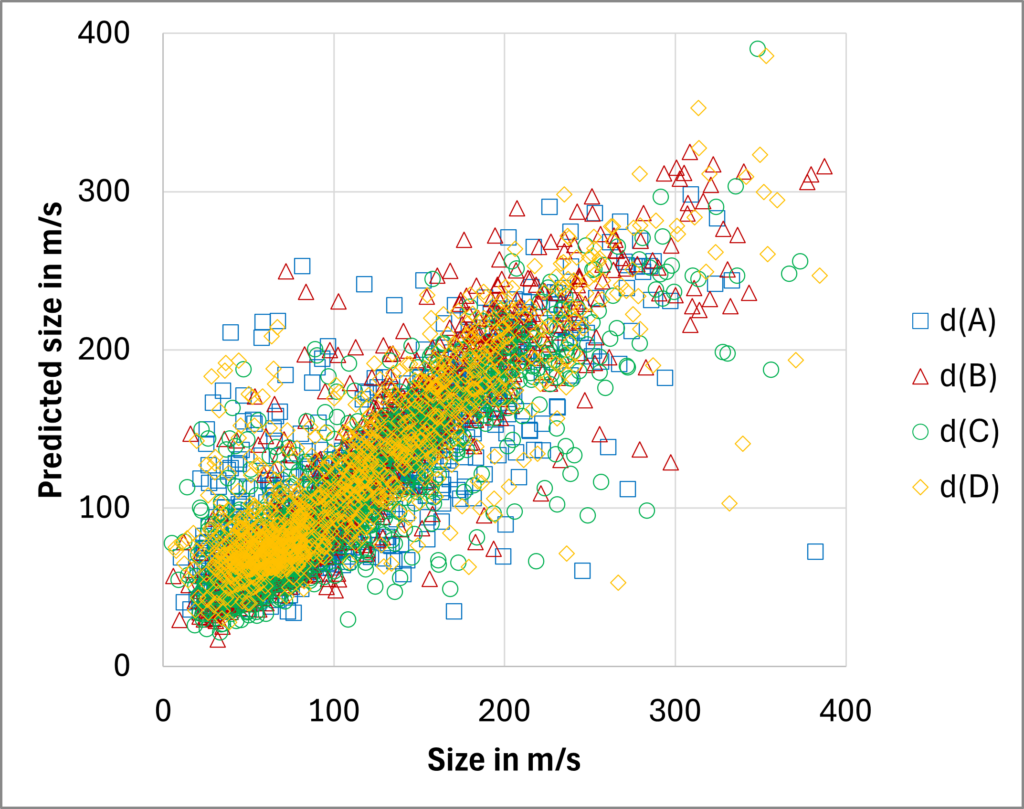
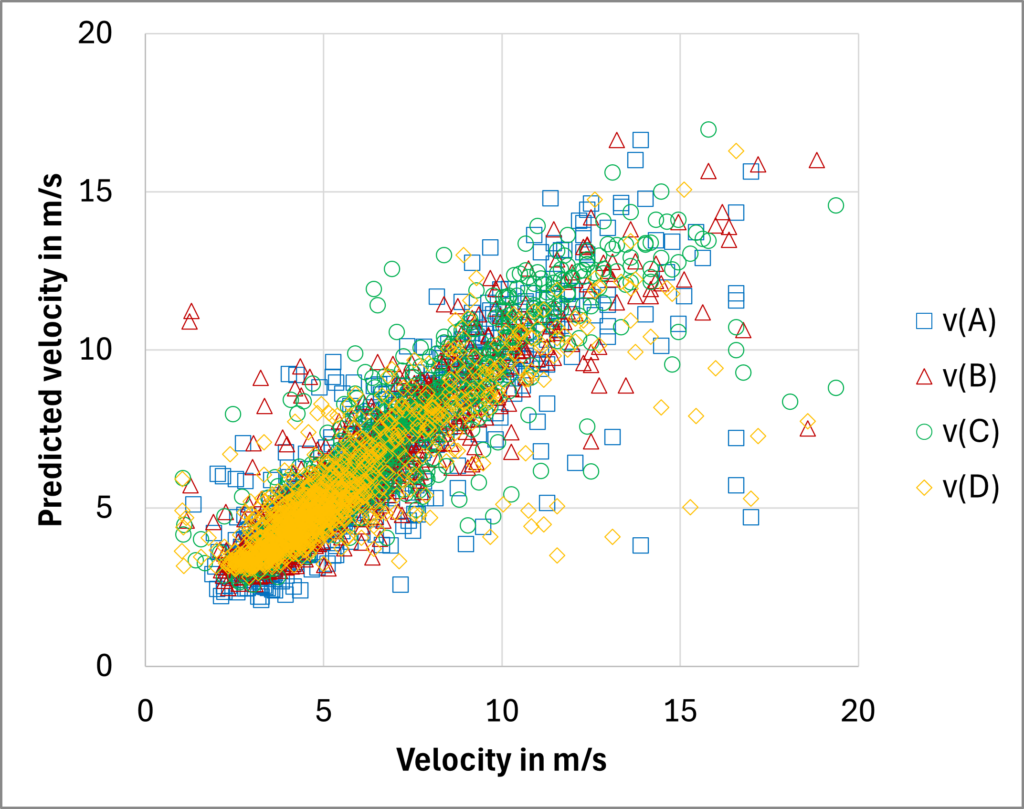
The training process then links the reference values to one selected waveform from that droplet. The selected waveform receives reference labels for size and velocity. Repeating this procedure for many droplets creates a dataset of measured signals and corresponding reference values. The machine-learning model uses this dataset to learn how the structure of one waveform relates to droplet size and velocity.
Training with Real Measured Light-Scattering Signals
The patented method [2] uses real measured light-scattering signals for AI training. These signals include effects from the actual optical setup, droplet path, detector, electronics, mechanical tolerances and spray conditions.
A complete mathematical model would require detailed information about the laser, optical geometry, detector, droplet path and material properties. Some of these values can change or may not be known precisely. Training with real signals allows the model to learn from the behavior of the actual measurement system.
References
[1] Schaefer, W., & Li, L. (2024). “Particle characterization by analyzing light scattering signals with a machine learning approach.” Applied Optics, 63(29), 7701–7707. https://doi.org/10.1364/AO.531346.
[2] Schäfer, W. “Method and device for characterizing particle properties by evaluating a scattered-light signal using a machine-learning model and reducing the primary apparatus.” German Patent Application DE102023134228A1. Assignee: ai-quanton GmbH.