
SQA1 System Configuration
SQA1 consists of two main hardware components:
- LSS1 optical measurement probe for detecting time-resolved light-scattering signals
- ZEON control unit for signal acquisition, processing and communication with the measurement software
The LSS1 configuration uses one active detector channel. It records a light-scattering signal from each detected droplet event. Depending on the selected configuration, the signal can be evaluated using classical signal analysis or an AI-based model.
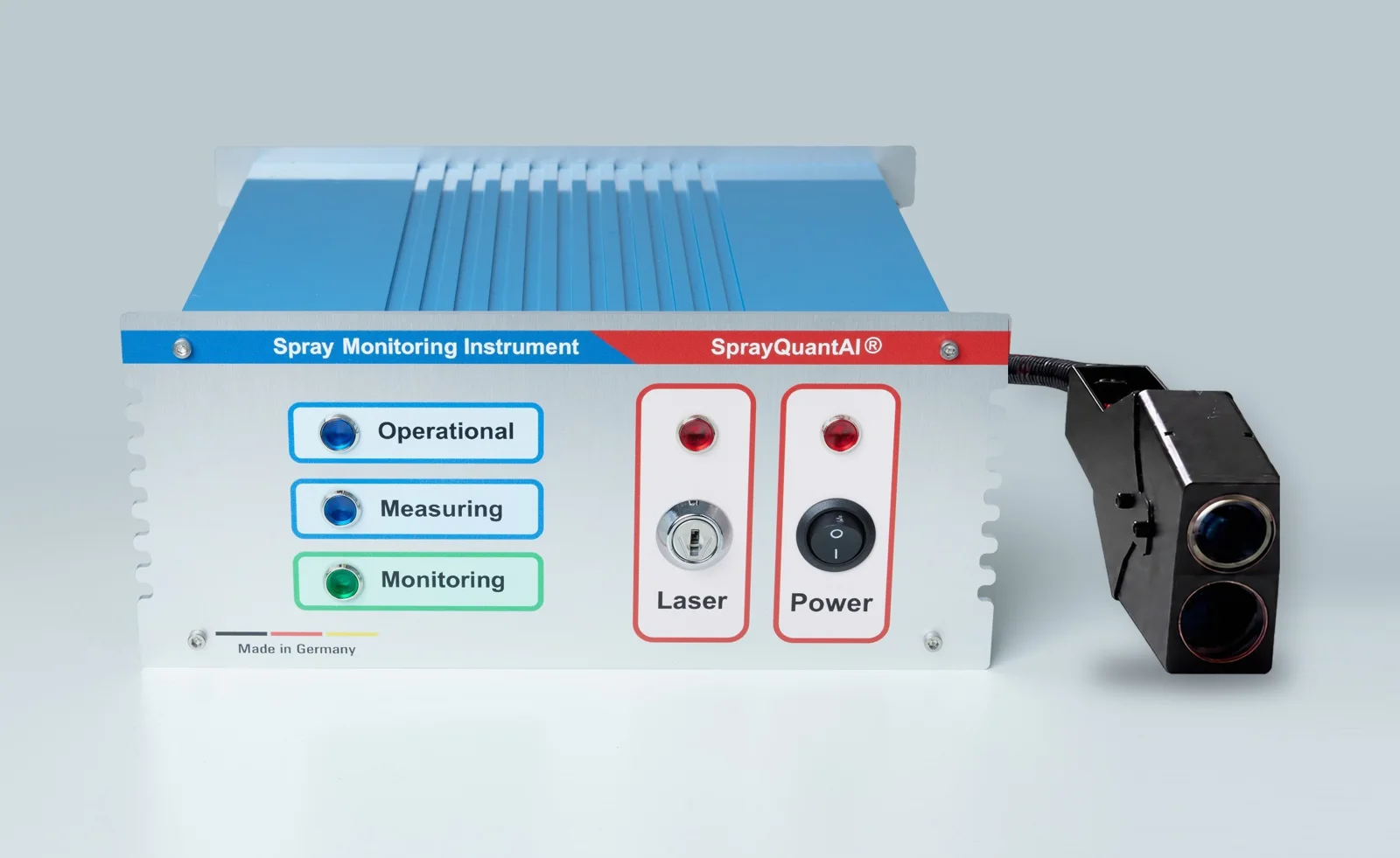
SprayQuantAI® SQA1 is a compact configuration for time-resolved measurement of individual droplets in sprays and flows. It combines the LSS1 optical measurement probe with the ZEON control unit. The system records light-scattering signals from individual droplet events and evaluates them using the selected measurement and software configuration.
Measurement Principle
When a droplet passes through the illuminated measurement region, it scatters part of the incident laser light toward the detector. LSS1 records the resulting signal over time. The signal contains information about the droplet and its interaction with the optical measurement region.
The ZEON control unit acquires and processes the signal. Depending on the selected evaluation method and calibration, SprayQuantAI® can determine quantities such as droplet size, velocity and droplet rate.
For AI-based evaluation, a trained model analyses the complete measured waveform. The model uses relationships learned from reference measurements to predict the selected droplet properties from one signal.
For more information about the two evaluation approaches, see the pages on the classical measurement principle [1] and AI-based measurement principle [2][3].
Typical Optical Configuration
| Parameter | Typical configuration |
|---|---|
| Optical probe | LSS1 |
| Control unit | ZEON |
| Active detector channels | 1 |
| Typical working distance | 125 mm |
| Available working distances | 62.5 mm, 125 mm and 250 mm |
| Typical laser wavelength | 405 nm |
| Typical laser power | 3 mW |
Measurement and Data Processing
The ZEON control unit connects the optical probe to the signal-processing and measurement software. It acquires the detector signal and provides the processed measurement data to the selected host or interface.
Depending on the application and software configuration, the system can provide individual droplet results and statistical spray parameters. Available outputs and interfaces depend on the selected ZEON configuration.
References
[1] W. Schaefer, C. Tropea, G. Wigger, and D. Eierhoff, “Spray measurements with the time-shift technique,” Meas. Sci. Technol., vol. 32, no. 10, p. 105202, Oct. 2021, doi: 10.1088/1361-6501/ac0467. https://iopscience.iop.org/article/10.1088/1361-6501/ac0467
[2] W. Schaefer and L. Li, “Particle characterization by analyzing light scattering signals with a machine learning approach,” Appl. Opt., vol. 63, no. 29, p. 7701, Oct. 2024, doi: 10.1364/AO.531346. https://opg.optica.org/ao/abstract.cfm?uri=ao-63-29-7701
[3] A. M. A. Doan, W. Schaefer, V. Chernoray, W. Schaefer, and V. Chernoray, “Analysis of the light scattering of a colloid droplet on a Gaussian beam to determine the suspension concentration,” in Proc. ILASS-Europe, Lund, Sweden, 2025.